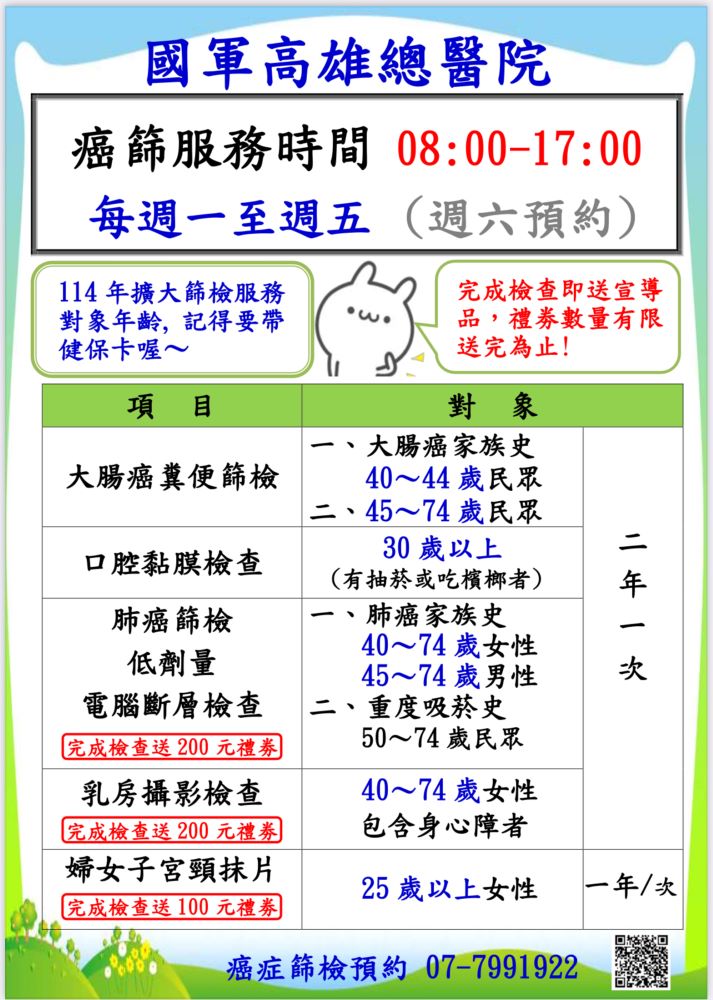


※Effective from January 1, 2025
Colorectal Cancer Screening_Fecal Occult Blood Test
Eligibility
45~74 years old or40~44 years old with a family history of colorectal cancer individuals; free screening every two years.
Screening Method
Simply bring your health insurance card to any medical institution to receive it.
Overview of Colorectal Cancer
Colorectal cancer is the most common cancer among the population, and its incidence is rapidly increasing each year. Approximately over 10,000 people are diagnosed with colorectal cancer annually, and nearly 4,000 die from it. Colorectal cancer can be detected early and treated early, with a very high cure rate. According to statistics, early-stage colorectal cancer, if properly treated, has a survival rate of over 90%.
Early symptom of colorectal cancer: blood in stool
Mucus in stool
Change in bowel habits (sudden diarrhea, then constipation)
Stool becomes thin
Frequent diarrhea or constipation
Weight loss
Anemia
If the tumor is larger, a lump can be felt
These symptoms do not necessarily indicate colorectal cancer, but if they persist for more than two weeks, you should see a specialist immediately.
How to Prevent Colorectal Cancer
Eat five servings of fruits and vegetables daily: eating more fruits and vegetables and less meat and greasy foods can reduce the chance of getting colorectal cancer by 20-50%.
Move a little each day: maintaining daily exercise helps the intestines move, can reduce the chance of getting colorectal cancer by 40%.
Screen every two years: regular fecal occult blood testing can detect colorectal cancer early and effectively reduce the death rate by 20%.
What is a fecal occult blood test
Fecal occult blood test is to check whether there is blood on the surface of stool that cannot be seen with the naked eye. Because tumors or polyps of colorectal cancer can be rubbed by stool and bleed, the blood adheres to the stool surface and is expelled, so through fecal occult blood testing early cases of colorectal cancer or polyps can be detected, and further diagnosis can be made via colonoscopy, receiving treatment early, thereby blocking the occurrence and progression of cancer, which can reduce the harm of colorectal cancer.
Currently, the fecal occult blood test uses quantitative immunological methods, requires no dietary restrictions, and is quite simple and convenient. However, the fecal occult blood test is not 100% accurate; if any abnormality occurs, one should still see a specialist for necessary examinations.
Colonoscopy results and subsequent management recommendations
1. Normal: No further action needed; it is recommended to have fecal occult blood testing regularly every 2 years.
2. Polyp found: Remove the polyp and follow up with colonoscopy as directed by the specialist.
If the fecal occult blood test is positive, it is recommended to go to colorectal surgery or gastroenterology/hepatology department for further colonoscopy; the advantage is that if any lesions or polyps are found during the examination, they can be biopsied or removed on the spot.
Relative survival rates for colorectal cancer
Year 1 82.5%
Year 2 72.5%
Year 3 65.9%
Year 4 61.5%
Year 5 58.3%
Early detection, early treatment
{Obesity increases the risk of breast and colorectal cancer, smoking and chewing betel nut can cause oral cancer; please control your weight and stay away from tobacco and betel nut}
Breast cancer screening_Mammography
Eligibility for screening
Women aged 40~74 can receive a free examination every two years.
Overview of breast cancer prevention and treatment
Breast cancer is the most common cancer among women in our country, ranking first. The peak incidence occurs between ages 45-64. Each year, nearly 7,500 people are diagnosed with breast cancer, and 1,600 die from it.
What are the high-risk groups for breast cancer?
Family history of breast cancer (mother, sister, daughter…)
Having had breast cancer in one breast
Having had ovarian cancer or endometrial cancer
Never having given birth or having the first child after age 30
Never breastfed
Early menarche, late menopause
Long-term use of hormone replacement therapy
The above risk factors make the chance of developing breast cancer slightly higher than that of the general population, but most breast cancers occur without any risk factors. Therefore, women should still pay attention to their breast health and not underestimate the threat of breast cancer.
How to prevent breast cancer
Exercise more
Avoid having children too late
Consume less high‑fat foods
Relax, reduce work stress
Regular screening
What is a mammogram?
Mammography is a technique that uses low‑dose X‑ray imaging of the breast. When performed in hospitals with strict quality control, the examination is very safe. It can detect breast calcifications or tumors and can identify asymptomatic stage‑0 breast cancer, making it a proven effective screening tool. However, mammography has its limitations; about 15% of breast cancers are not detected by X‑ray mammography, so even if the results are normal, any abnormal findings before the next scheduled screening should prompt prompt medical attention.
What should be noted when undergoing mammography screening?
During the exam, you must remove clothing from the upper body, so do not wear jumpsuits or dresses.
Do not apply deodorants, powders, or skin creams to the breasts or armpits, as they can create artifacts that affect diagnosis.
During imaging, the breast is compressed for about 3 seconds, which can be uncomfortable; therefore, the week before menstruation is less suitable for the exam.
What should be done if the test results are abnormal?
You should promptly seek an experienced specialist physician for further examinations, such as breast ultrasound, fine‑needle aspiration, and tissue biopsy, to determine whether it is breast cancer. Once breast cancer is diagnosed, you should follow the doctor's instructions, receive appropriate treatment, and have regular follow‑up appointments for monitoring.
Below are the subsequent management steps for different test results; the physician may still make appropriate adjustments based on individual circumstances.
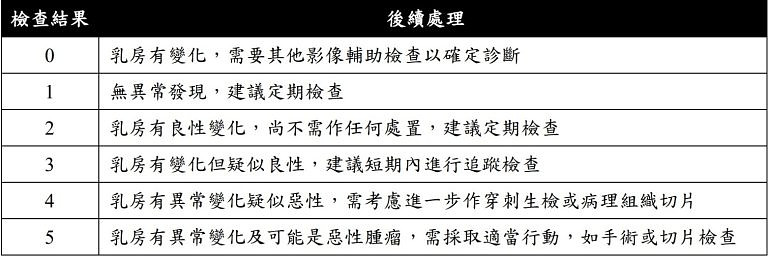
◎Mammography results of 0, 3, 4, 5 require a prompt return visit for further examination.
Each screening can have false‑negative cases, so even if the results are normal, any abnormality should be promptly evaluated by a doctor.
If breast cancer is detected early, what is the survival rate?
When breast cancer is detected early, not only can breast‑conserving surgery be performed, but the 5‑year survival rate can exceed 90%. Breast cancer staging is based on tumor size, presence of axillary lymph node metastasis, and distant metastasis; the earlier it is found, the higher the survival rate.
Breast Cancer Staging 5‑Year Survival Rates
Stage 0 91~98%
Stage 1 90~96%
Stage 2 84~89%
Stage 3 55~67%
Stage 4 18~38%
Early detection, early treatment
{Obesity increases the risk of breast and colorectal cancer; smoking and chewing betel nut can cause oral cancer. Please control your weight and stay away from tobacco and betel nut}
Oral Cancer Screening_Oral Mucosal Examination
Eligibility for Examination
Individuals aged 30 or older who smoke or chew betel nut (including former users), or indigenous people aged 18 or older who chew betel nut (including former users). Free examination once every two years.
What is an oral mucosal examination?
Oral mucosal examination is performed by doctors visually or by palpation of the oral mucosa to see if there are signs of suspected precancerous lesions or cancer. It is painless and has no side effects. The purpose of oral mucosal examination, besides early detection of oral cancer, is more importantly to identify precancerous lesions for appropriate treatment, thereby preventing the occurrence of cancer, and through health education, advise cessation of betel nut and smoking; this can improve some mild or superficial lesions and also reduce the risk of future precancerous lesions and cancer.
However, no test is 100% accurate; if any abnormality occurs in the body, please seek medical examination promptly. Before the examination, please clean the oral cavity thoroughly.
What to do if the test results are abnormal?
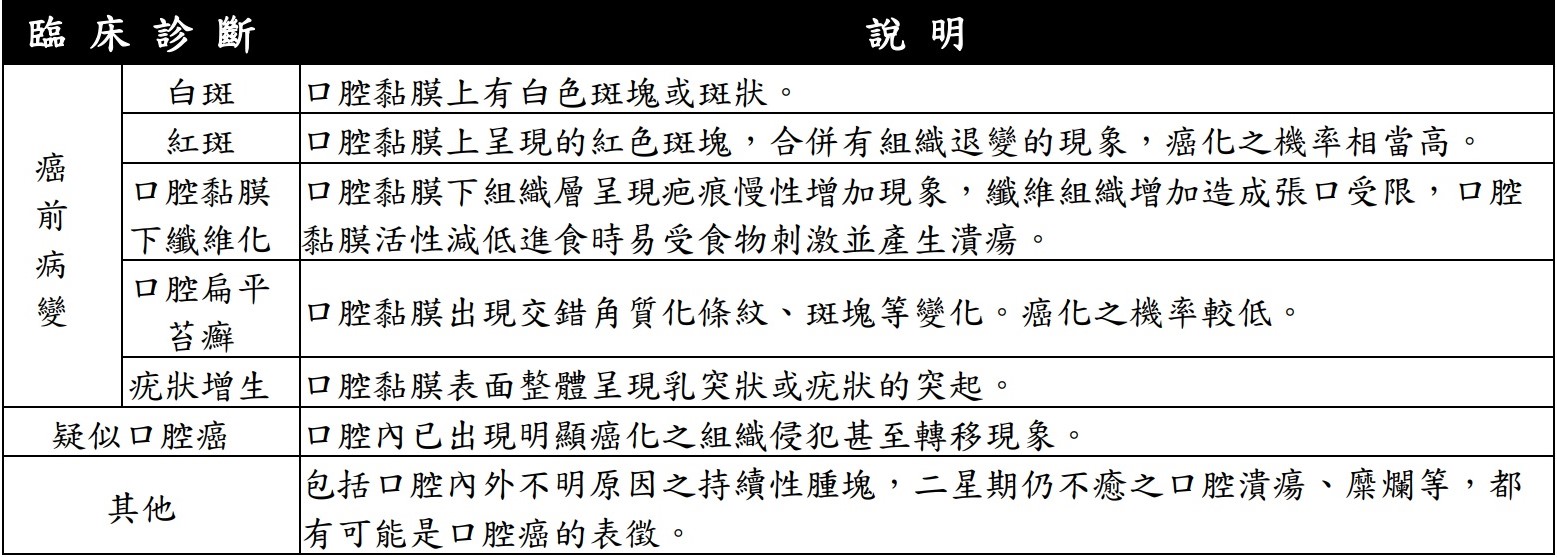
If the oral mucosal examination reveals suspected precancerous lesions (leukoplakia, erythroplakia, oral submucous fibrosis, lichen planus, verrucous hyperplasia, etc.) or suspected oral cancer, please promptly go to a hospital's oral surgery or ENT department for diagnosis, and follow the doctor's advice to have regular follow‑up every 3–6 months. In addition, immediately quit betel nut, smoking, and alcohol, and avoid hot or irritating foods.
Symptoms of oral cancer
Symptoms of oral cancer include: abnormal swelling, thickening, or the appearance of white or red patches inside the mouth; oral mucosal ulcers that do not heal after more than ten days; unexplained bleeding, pain, or numbness in the mouth without any irritation; difficulty opening the mouth, difficulty moving the tongue, etc. When any of these signs are observed, be alert and promptly go to a hospital for further oral mucosal examination.
Explanation of oral precancerous lesions
Oral cancer relative survival rate
One year 77.8%
Two years 63.2%
Three years 57.6%
Four years 54.0%
Five years 51.1%
Early detection, early treatment
{Obesity increases the risk of breast and colorectal cancer, smoking and chewing betel nut can cause oral cancer, please control weight and stay away from tobacco and betel nut}
Cervical Cancer Screening_Cervical Pap Smear Test
Eligibility for Screening
Women over 25 with sexual experience, free screening once a year (or at least once every three years).
Current Situation of Cervical Cancer
Cervical cancer is one of the most common cancers among women; each year there are about 1,700 new cases diagnosed and 700 deaths from cervical cancer, therefore cervical cancer is a disease that women cannot ignore.
High-risk Groups
All women with sexual experience, especially those who married early, have many children, or have multiple sexual partners, should pay special attention and undergo a cervical pap smear once a year (or at least once every three years)!
How Cervical Cancer Develops
The vast majority of cervical cancers are caused by infection with human papillomavirus (HPV) through sexual activity; most infections resolve on their own, but a small proportion of persistent infections can later develop into precancerous lesions and even cervical cancer.
What is Human Papillomavirus?
Currently, about 40 types of HPV are known to infect the skin and mucous membranes of the anal and genital areas, and about 17 high-risk types are associated with cervical cancer. Among them, types 16, 18, 52, and 58 are the more common high-risk types in Taiwan, while types 6 and 11, which cause condyloma acuminata (commonly called genital warts), are low-risk types.
There is currently no medication to cure HPV infection, but cervical cancer and genital warts can be treated locally.
How to Reduce the Risk of HPV Infection?
Avoid engaging in sexual activity too early.
Reduce the number of sexual partners.
Practice safe sex, use condoms.
Get the cervical cancer vaccine.
What is a Pap smear?
Pap smear testing is the best way to prevent cervical cancer. The Pap smear procedure is simple and usually not painful. During the sampling, a speculum is inserted into the vagina, and a small wooden stick or brush is used on the cervix to gently scrape a small amount of exfoliated epithelial cells, which are smeared onto a slide, stained, and examined under a microscope for any suspicious cancer cells. The purpose of the Pap smear is to detect precancerous lesions and provide appropriate treatment, thereby preventing the development of cancer.
Precautions before the test
Do not rinse the vagina.
Avoid soaking in a bathtub.
Do not insert any suppositories.
Abstain from sexual activity the night before.
Avoid the test during menstruation.
Follow-up diagnosis
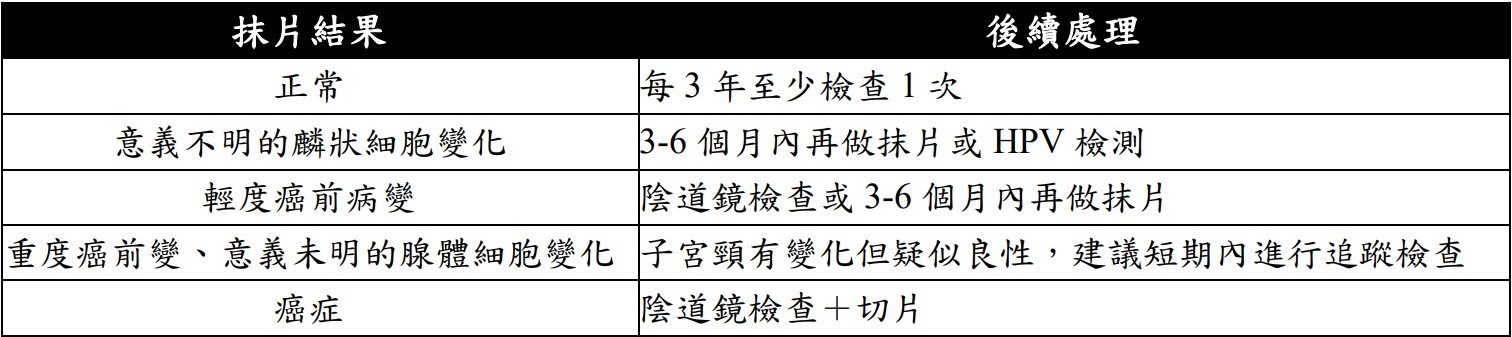
Because the Pap smear collects cervical epithelial cells to be examined under a microscope for abnormalities, further testing is required to confirm a diagnosis and determine if treatment is needed.
Cervical Cancer Relative Survival Rate
First year 91.0%
Second year 83.5%
Third year 78.9%
Fourth year 75.6%
Fifth year 73.2%
Early detection, early treatment
Lung Cancer Screening_Low-dose CT scan
Eligibility Criteria
1. With a family history (1) 45 to 74 years old male (2) 40 to 74 years old female, whose parents, children, or siblings have been diagnosed with lung cancer. Or 2. Heavy smoking history: ages 50 to 74 with a smoking history of 20 packs‑per‑year or more and who are willing to quit smoking or have quit within the past 15 years as heavy smokers. Free screening every two years.
What is a low‑dose computed tomography scan?
Low‑dose chest computed tomography (Low Dose CT) is a chest CT examination that does not require contrast injection, so the person being examined receives a relatively low radiation dose while effectively achieving early‑lung‑cancer screening. Lung cancer is usually diagnosed by chest X‑ray, PET scan, CT scan, etc., and low‑dose CT (LDCT) is a type of CT scan with lower radiation exposure. The examination takes only about 5 minutes and can scan the entire lung, and it is currently medically proven to be suitable for lung‑cancer screening.
What should be done if the test results are abnormal?
International statistics vary, but anyone who undergoes a CT scan has about a 50% chance of having small nodules detected in the lungs; some people may have one or more small nodules simultaneously, most of which are benign. Therefore, if a report shows small nodules in the lung, do not panic, because the vast majority are benign granulomas. Follow the physician’s instructions, usually by adopting a surveillance approach, and only consider further examinations—such as PET scans or CT‑guided biopsy—if necessary. In most cases, there is still sufficient time to take appropriate measures.
For these indeterminate small nodules, there are international guidelines and recommendations for follow‑up. Clinically this requires comprehensive judgment; physicians usually decide based on nodule size, shape, characteristics, and whether the patient belongs to a high‑risk group for lung cancer, whether immediate intervention is needed or continued surveillance for up to 2 years or even less than 5 years. Calcified small nodules are benign and do not require follow‑up. However, most small nodules are indeterminate and need surveillance to aid diagnosis. If a nodule enlarges during follow‑up, the physician will recommend a biopsy or other examinations; if it is confirmed as lung cancer, it is usually still early stage and surgical outcomes are good.
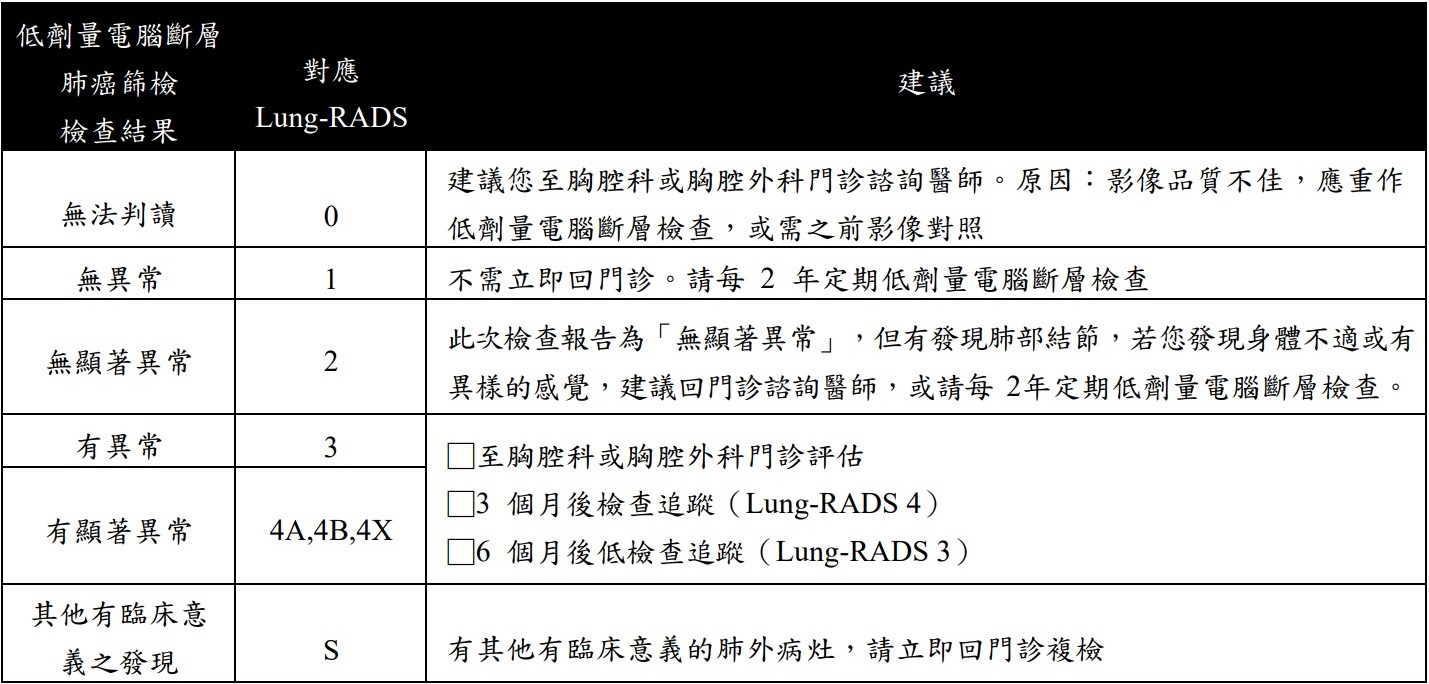
◎ Lung cancer screening low‑dose CT results of 0, 3, 4A/4B/4X, S; should promptly return for further examination.
Any screening can have false‑negative cases, so even if the result is normal, any abnormality should be evaluated promptly.
Lung cancer 5‑year survival rate
Stage 0 100%
Stage 1 93%
Stage 2 59%
Stage 3 30%
Stage 4 11%
Early detection, early treatment
{Obesity increases the risk of breast and colorectal cancer; smoking and betel nut chewing can cause oral cancer. Please control your weight and stay away from tobacco and betel nut}