





Smoke‑Free Betel Nut Hospital Section
The Kaohsiung Armed Forces General Hospital bears the sacred mission of safeguarding the medical health of both military and civilian populations in the southern region. This section was established primarily to integrate resources within each county and city health bureau, implement the standards of the global smoke‑free betel‑nut health care service network, achieve cross‑disciplinary professional manpower integration, expand medical staff participation in smoking and betel‑nut cessation services, and maintain a smoke‑free betel‑nut environment as part of the hospital’s obligations. It also collaborates with local governments and community resources to create a supportive smoke‑free betel‑nut environment across various settings (including communities, workplaces, campuses, military camps, etc.), providing high‑quality cessation services and education on the harms of tobacco and betel nut, thereby enhancing public and military personnel recognition of tobacco and betel‑nut harm prevention, and jointly constructing a smoke‑free betel‑nut environment as the ultimate goal.
Smoke‑Free Betel Nut Hospital Policy
Kaohsiung Armed Forces General Hospital Smoke‑Free Betel Nut Hospital Policy
I. Origin
The World Health Organization reports that tobacco claims over 7 million lives each year, with more than 6 million deaths attributable to direct tobacco use and about 890,000 non‑smokers dying from exposure to secondhand smoke. Overall, on average, one person dies from tobacco‑related causes every five seconds. In Taiwan, approximately 24,000 smokers die from smoking and nearly 2,600 non‑smokers die from secondhand smoke, meaning a tobacco‑related death occurs on average every 20 minutes. In addition, Taiwan’s high betel‑nut chewing rate is a major cause of the high incidence and mortality of oral cancer, with over 6,000 new cases and more than 2,000 deaths from oral cancer each year.
Therefore, our hospital, together with the National Health Agency, actively promotes tobacco and betel‑nut control work. In addition to strengthening tobacco‑betel‑nut prevention education through multiple channels and creating a smoke‑free and betel‑nut‑free environment, we provide cessation services, offering staff, patients, and the public a fresh, safe, and hygienic environment to protect public health.
II. Policy Pledge
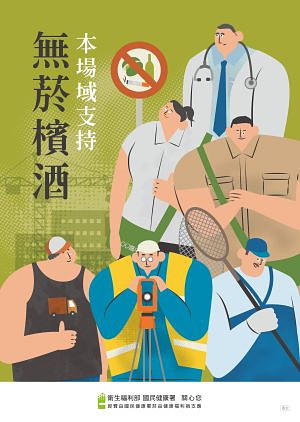
Our hospital aims to create a smoke‑free betel‑nut hospital and workplace, with a complete ban on betel‑nut chewing both indoors and outdoors on the campus. We invite hospital staff, outsourced personnel, partner vendors, volunteers, patients, and community members to join the effort, becoming part of the “Combat Betel Nut – Oral Cancer OUT” campaign.
III. Scope of Smoking and Betel‑Nut Ban
1. The hospital’s announced property area (within the perimeter wall), including all buildings—lobbies, dormitories, offices, clinical areas, conference rooms, wards, lounges, stairwells, restrooms, medical facilities, as well as enclosed spaces of official transportation vehicles—and outdoor areas such as gardens, lawns, parking lots, and driveways, are all designated as smoke‑free betel‑nut zones.
2. This policy applies to all employees, outsourced personnel, interns, volunteers, job seekers, patients, family members, vendors, and visitors who enter the hospital campus.
IV. Implementation Measures
1. Smoke‑Free Betel Nut Hospital Policy:
(a) Include the hospital’s no‑betel‑nut provisions in employee employment contracts and incorporate them into the HR onboarding checklist.
(b) Conduct a survey of all hospital staff (including outsourced units or partner vendors) regarding smoking and betel‑nut use, and provide individual health education to those who smoke or chew betel nut.
(c) The Director of the Department of Community Medicine is responsible for supervising the promotion of the smoke‑free betel‑nut hospital policies and services; members of the Cancer Screening Team implement the policies and services.
(d) The Cancer Screening single‑window establishes a cessation education service point, offering smoking and betel‑nut cessation counseling.
(e) Establish a reward policy:
1. Provide incentives to staff who refer colleagues for cessation education.
2. Offer rewards to individuals who chew betel nut and receive cessation education, and to those who successfully quit.
2. Measures to create a smoke‑free betel‑nut hospital:
(a) Clearly display no‑chewing signs or health‑hazard posters, slogans, flyers, and scrolling messages at entrances, parking areas, high‑chewing zones, etc., and announce the hospital’s no‑betel‑nut policy.
(b) Conduct tobacco‑betel‑nut prevention education: at least two print reports (press releases, hospital publications, etc.), internet (hospital website with permanent tobacco‑betel‑nut prevention information), and hospital TV broadcasting prevention segments (at least one slot daily).
(c) Form an inspection team (volunteers, security staff, or administrative personnel) to patrol the hospital interior and exterior for betel‑nut residue, conduct repeated inspections and education in high‑chewing areas, and keep records.
(d) Enhance awareness among staff, partner vendors, and visitors about the health hazards of tobacco and betel nut and the “Smoke‑Free Betel Nut Hospital” policy.
(e) Organize at least four related activities (including educational talks/activities on “Health Hazards of Tobacco and Betel Nut” and the December 3 Tobacco‑Betel‑Nut Prevention Day event).
3. Cessation Education Information
(a) Cessation website:
Foundation for Cancer Prevention Education, http://www.caprevention.org.tw/ (opens in a new window)
Taiwan Cessation Education Alliance
(b) Cessation service hotlines
1. Foundation for Cancer Prevention Education: (02) 2809‑9595.
2. Cancer Screening Team: 07‑7493569.
4. Disciplinary actions for staff violating the smoking and betel‑nut ban
(a) Employees or interns who violate the hospital’s smoke‑free betel‑nut policy, after verification, will be recorded and included in routine performance assessments, and linked to annual evaluations (performance or internship grades) according to the severity of the conduct.
(b) Outsourced personnel who violate the no‑smoking/chewing policy will have the violation photographed as evidence, and the contracting unit will be referred to handle fines as stipulated.
V. Other matters not covered herein may be amended separately.
