




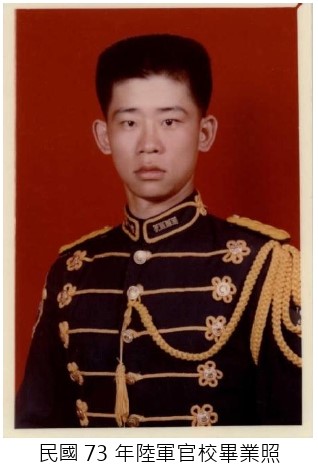
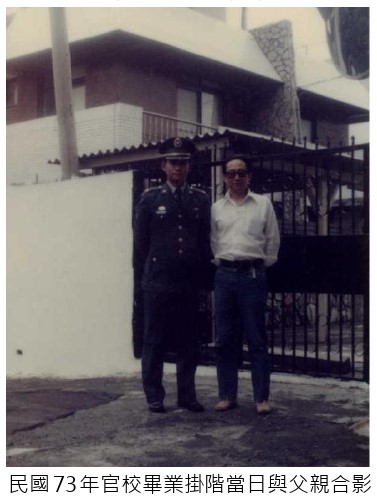
I am Yu Zhih‑lun, currently serving in the 802 Health Protection Office. Because my father was also a professional soldier, after graduating junior high in the 65th year of the Republic I entered the Chung Cheng Preparatory School. At that time, Chung Cheng Preparatory School differed from other regular high schools in that, besides studying, there was strict militarized management of daily life, along with many basic training activities such as marching. After graduating from the preparatory school, in the 69th year of the Republic I directly entered the Army Officer Academy. I chose the infantry as my officer specialty and studied in the civil engineering department, so I have some knowledge of civil engineering. After graduating from the officer academy in the 73rd year of the Republic, I was directly commissioned as a second lieutenant and assigned to a unit.
I was assigned to a unit in Hualien and Taitung; I was placed in the Taidong Taiping Camp, and later transferred to Yuli, Qixingtan, and Sanzhan in Hualien, so from the 73rd to the 76th year of the Republic I was in the Hualien–Taitung area. In August of the 76th year, I was rotated to Xiju, Matsu, as a company commander. At that time, the frontline troops were stationed in bunkers and tunnels. In summer, the floor of the bunkers and tunnels would accumulate 2 to 3 cm of water, making them very damp and unsuitable for human habitation. Coincidentally, a policy at that time aimed to provide better living facilities for the outlying island personnel, so we built toilets, warehouses, and barracks next to the tunnels. Because I had a civil engineering background, tasks ranging from reading engineering blueprints, staking out, excavating foundations, tying rebar, assembling formwork, to pouring concrete were all manageable. The buildings constructed then had roofs 1.2 m thick and walls 80 cm wide to resist artillery fire from the opposite side. Previously I had only learned theory at school; it was in Matsu that I gained practical engineering experience.
I stayed in Matsu for a full two years. In August of the 78th year, I was rotated back to the 203rd Division in Guantian, Tainan, serving as the company commander of the division headquarters. Afterwards, I became a battalion operations officer and attended a six‑month regular training course at the Infantry School. After completing the regular class, I returned to the division headquarters as a mobilization officer in Section One. In the 80th year, I was transferred to the Army Logistics Command in Longtan, Taoyuan (which at that time was co‑located with the Army Headquarters in the Da‑Han Camp) as a personnel officer, handling personnel matters for all officer specialties except infantry, artillery, and armor. In August of the 82nd year, a logistics officer position opened at the 802, so I applied for the selection.
At the 802, I have served as a logistics officer, an administrative officer, and a personnel officer; at that time the administrative section had three major‑rank positions available. The 802 Hospital was built in the 66th year of the Republic. When I arrived at the 802, the required space and design standards had changed, because previously military hospitals only served military personnel and their families, while civilians were treated at the public clinic on Jianguo Road. With the implementation of universal health insurance in the 86th year, the hospital also planned to integrate military and civilian medical services, so space was insufficient. During Director Meng Xiang‑yue’s tenure, the unused areas of the existing buildings were repurposed, and the vacant courtyard was covered to create examination rooms, increasing treatment space.
Director Meng was a very approachable and employee‑concerned superior, and also very forward‑looking. I recall a meeting where a department’s drug expenses were excessively high; Director Meng asked for the reason, and the department head replied that there were several soldiers in the department and suggested not prescribing such expensive medication to them in the future. Director Meng retorted on the spot: “If we don’t take care of the soldiers, what is the purpose of our hospital? Why does the state let you study at the National Defense Medical College?” He was truly a decisive and soldier‑caring director!
The current second‑floor internal medicine ICU ward of the hospital was originally planned to be a dialysis center. During the transition between outgoing and incoming directors, Director Meng, after assessment, decided to split the ICU into internal and surgical ICU units, converting the half‑completed dialysis center into an internal medicine ICU ward.
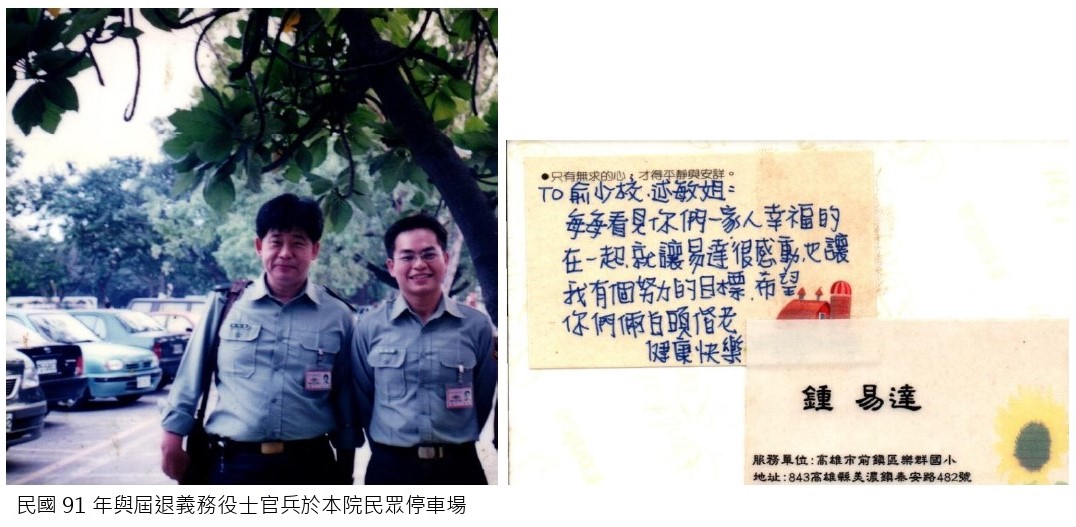
In the 92nd year of the Republic, as my service was drawing to a close, I had the opportunity to continue working in the Health Protection Office. After being discharged, I took annual leave and returned to work at the 802. Up to now, I have served at the 802 for nearly 32 years, and I am grateful for the hospital’s care over all these years.
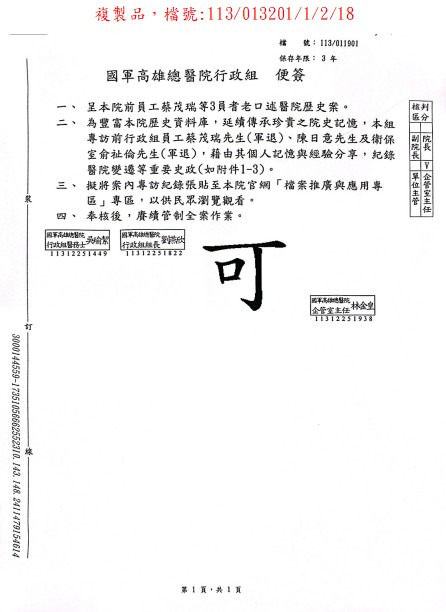
Copy, file number: 113/013201/1/2/18
