





Say no to unwanted advances: a guide to recognising unwanted pursuit. Produced by the National Police Agency, Ministry of the Interior.
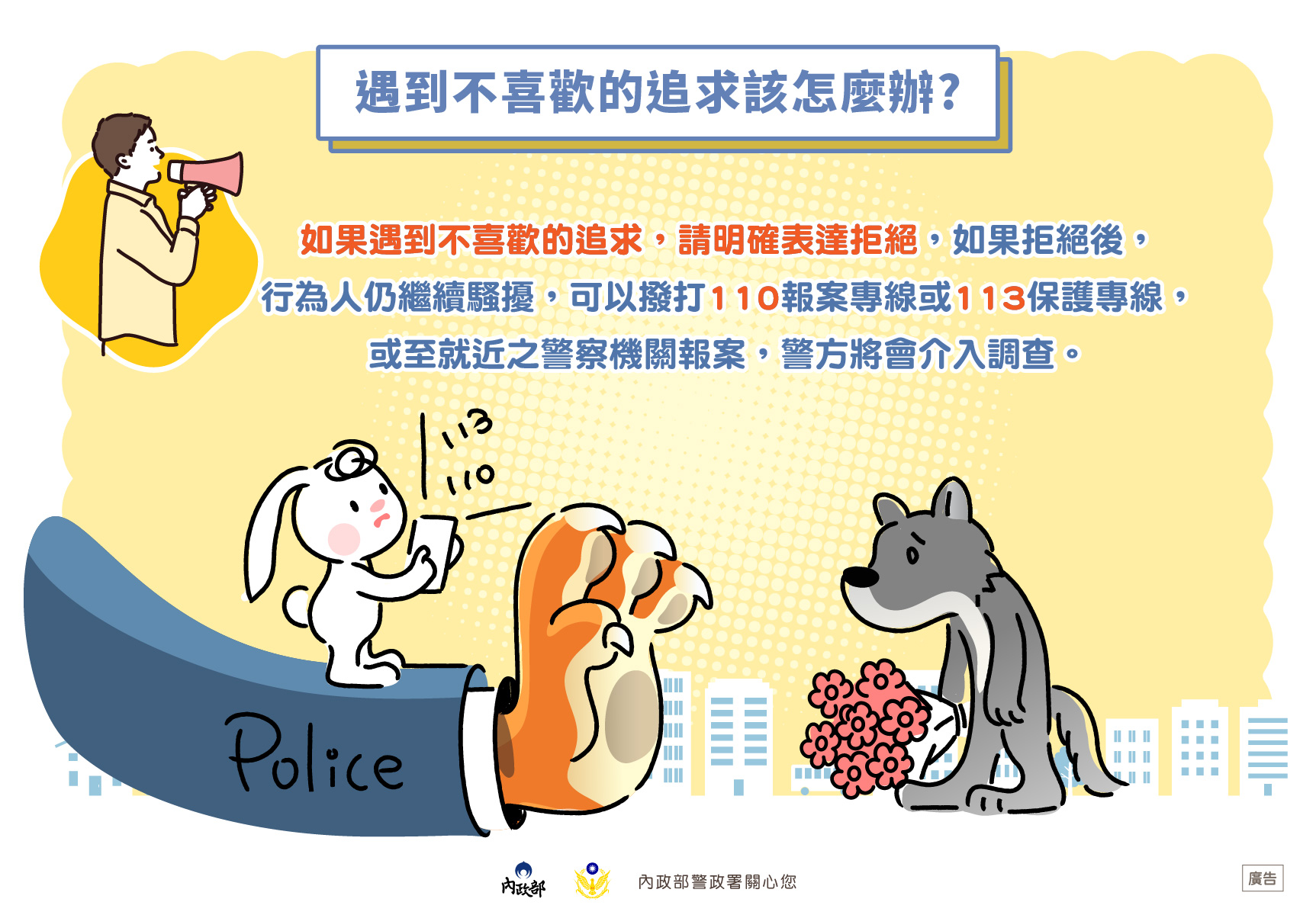
What should you do about advances you do not welcome?
Make your refusal clear. If the other person continues to harass you after you have refused, call 110 for the police or 113 for the protection hotline, or report the matter at your nearest police station. The police will investigate.

What should you do about advances you do not welcome? (continued)
You may press charges, and the police will investigate the case as stalking and harassment. You may also request that a written warning be issued: if the investigation shows that the conduct may constitute stalking and harassment, the police will issue a written warning and order the conduct to stop. If the person offends again within two years of receiving the written warning, you may apply to the court for a protection order.

Unacceptable forms of pursuit
If, after the person you are pursuing has refused you, you repeatedly do any of the following and thereby cause fear, hostility or offence and disrupt that person's daily life, your conduct is unwanted pursuit and may constitute sexual harassment or stalking:
- Sending or leaving objects
- Tracking a specific person's movements
- Sending obscene images, text or recordings
- Harassing by telephone, in speech or by message
- Waiting at places the person frequents in order to stage chance meetings
- Inappropriately touching the body or private parts
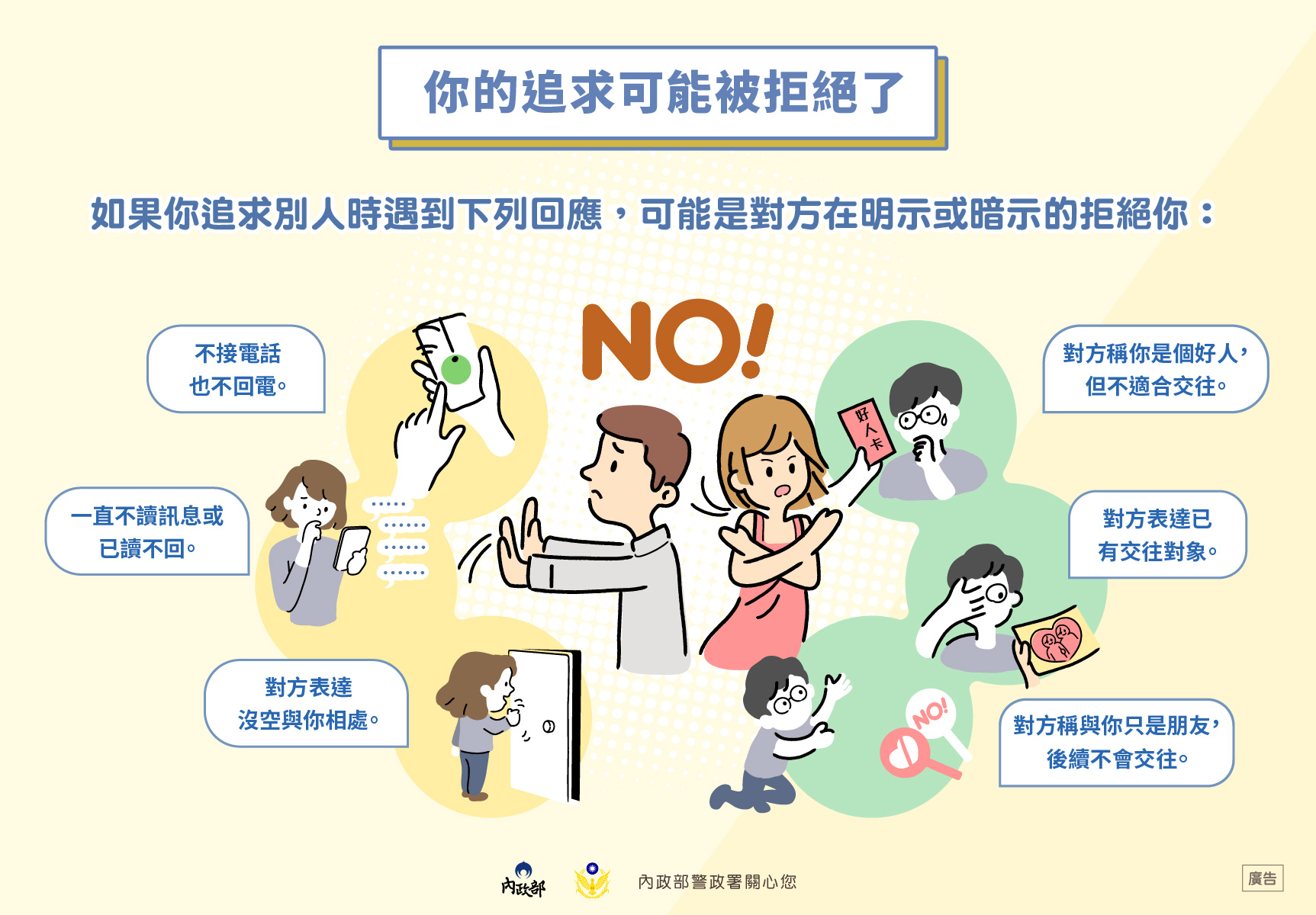
Your advances may already have been refused
If you meet any of the following responses, the other person may be refusing you, either directly or indirectly:
- Not answering your calls and not calling back
- Leaving your messages unread, or reading them without replying
- Saying they have no time to spend with you
- Saying you are a good person but not someone they would date
- Saying they are already in a relationship
- Saying you are only friends and that will not change
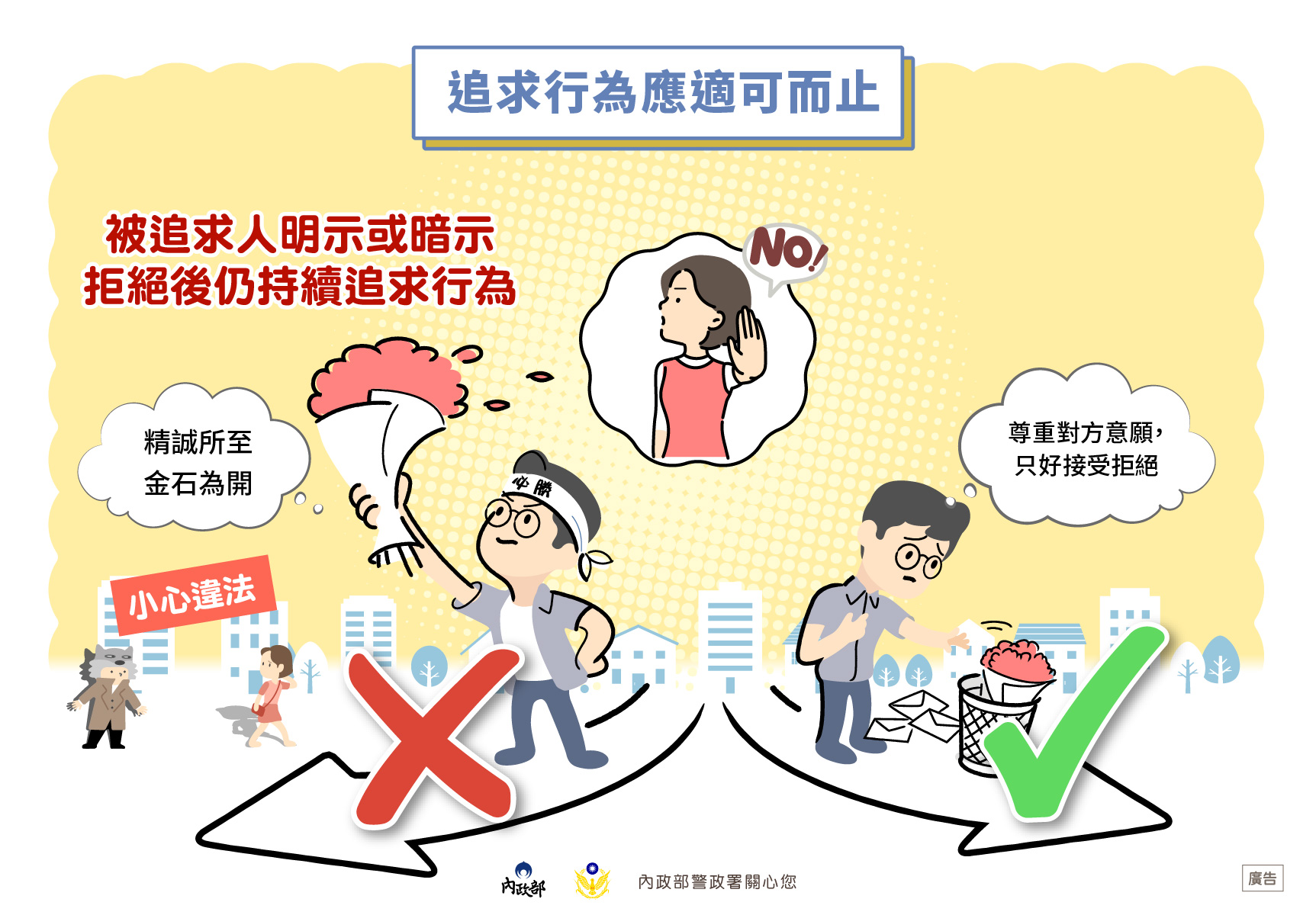
Pursuit should stop at the right point
Continuing to pursue someone after they have refused you, whether directly or indirectly, in the belief that persistence will win them over, risks breaking the law. Respecting the other person's wishes and accepting a refusal is the right course.
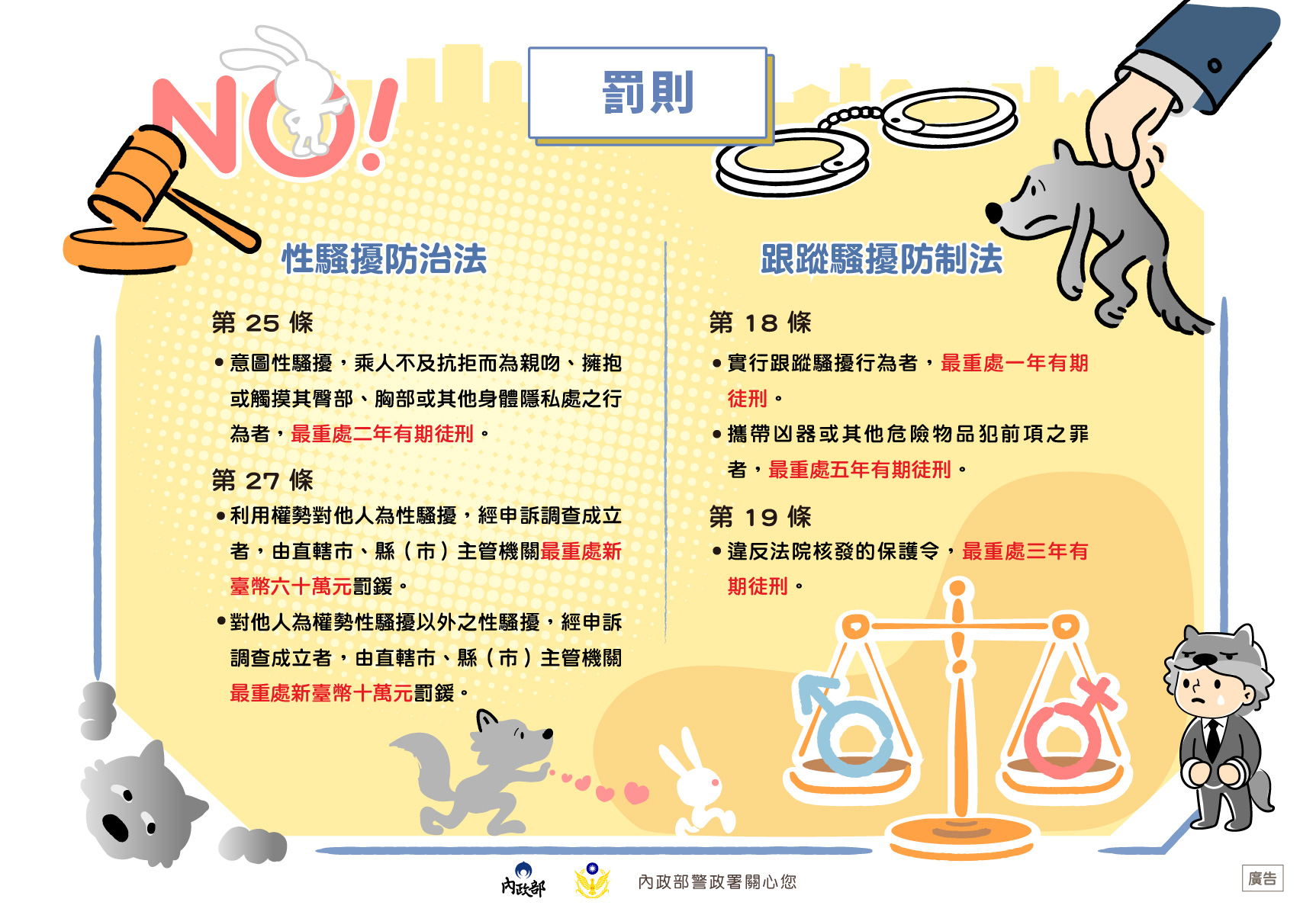
Penalties
Sexual Harassment Prevention Act
- Article 25: a person who, with intent to sexually harass, takes advantage of another's inability to resist in order to kiss, embrace or touch that person's buttocks, chest or other private parts of the body faces up to two years' imprisonment.
- Article 27: where a complaint of sexual harassment involving abuse of power is upheld, the competent municipal or county authority may impose a fine of up to NT$600,000; where an upheld complaint concerns sexual harassment not involving abuse of power, the fine may be up to NT$100,000.
Stalking and Harassment Prevention Act
- Article 18: a person who engages in stalking or harassment faces up to one year's imprisonment; where the offence is committed while carrying a weapon or other dangerous object, the penalty is up to five years' imprisonment.
- Article 19: breaching a protection order issued by the court carries up to three years' imprisonment.
